- jackass world
- Posts
- dangerous personalities: a study of rockstardom
dangerous personalities: a study of rockstardom
on an impossible guitarist and a west chester reject

Credit: April Margera
I have been thinking about dangerous rock stars this week.
I’ve been thinking about the gun Elvis kept holstered on his ankle and how Charlie Manson listened to The Beatles. I’ve thought about when Sid Vicious carved up his own chest onstage, when The Kingsmen were tracked by the FBI, when The Who ignited explosives on TV, when The Kinks were banned from America, and when Nikki Sixx came back from the dead. I’ve thought about the several times Ozzy Osbourne decapitated animals, the time The Stooges fought bikers, the times Liam Gallagher brawled in bars, and the times Henry Rollins lost fights with his crowd. And obviously, I have been thinking about the most dangerous rock star of them all: Keith Richards.
A lot of people say this reputation started in a 700-year-old cottage — the time that, hot off the heels of releasing Between the Buttons, Keith Richards hosted a party at the Redlands estate.
There’s a glamour to this setting, but it really wasn’t even a real party; it was more like a gathering of friends who happened to be the most famous people in the world, on the comedown from an acid trip. However, after months of tracking rumors and following tips, the police raided the cottage, charged Richards with his first drug offense, and threw him in jail for the night with a prison sentence looming over his career. (Mick Jagger was also charged, but this is about Keith Richards.) This was right after they released “Ruby Tuesday” — for any other band, this would have been career-ending, but the future of The Stones was made that night.
There’s this old Stones documentary called Charlie Is My Darling that really captures them during the moments they became Famous, a brief second where they were straddling the world of uncomfortable matching suits they came from and the world of dangly earrings and shaggy hair they were about to invent. The documentary starts with some typical boybandom, including footage of a fan ripping Richards’ hair out while he crooks his neck to light his cigarette, but the real Early Danger is caught in the ordinary.
Peter Whitehead can’t help it; anywhere he points the camera, Richards’ effortless coolness unfurls around the band, like the scene backstage where Richards’ chilly air of indifference wraps around the camera recording his face. The guitar in his hands and the riff he’s working out are far more interesting than whatever this documentary is. He knows that he’s dangerous already.
So in 1967, just overnight, the Rolling Stones became The Most Dangerous Band in the World. And the reputation stuck with them, especially with Richards, who only grew further and further into this heartbroken criminal complex he had built up. He looks the part too: under his long, dark hair, he has a natural snarl and a wicked glint in his eye when he’s not wearing sunglasses. The danger had really always been there.
In the next year, Richards would grow out that hair and unbutton his shirt. He would write “Paint It Black” and start dating Anita. His drug habit would get harder and define the rest of the decade and the next one and probably the next one. From then through the ‘70s, he would write Sticky Fingers and Exile on Main Street and get arrested, he would get into heroin and write more. He would get arrested again, and Mick Jagger would allegedly sing “Hands of Fate” about him, and when everyone thought he would die, Keith would write Some Girls.
He became a hero, a warning, a legend, a fable. Yet, his edge is very real and helped keep the Rolling Stones feel dangerous too. And that’s the point of this essay. Not just the reality of dangerous public personalities, but the feeling of dangerous public personalities.
There’s a sacrificial nature to all this. In order to maintain aesthetic authenticity, there is no escape out of this lifestyle. This is what makes icons. But it also makes tragedy.
I don’t have to explain how this connects to Jackass. The entire franchise is built on this aesthetic and authentic sacrifice. Jackass is run by guys who grew up watching those exact showmen they emulate.
But Jackass has a true rock star.
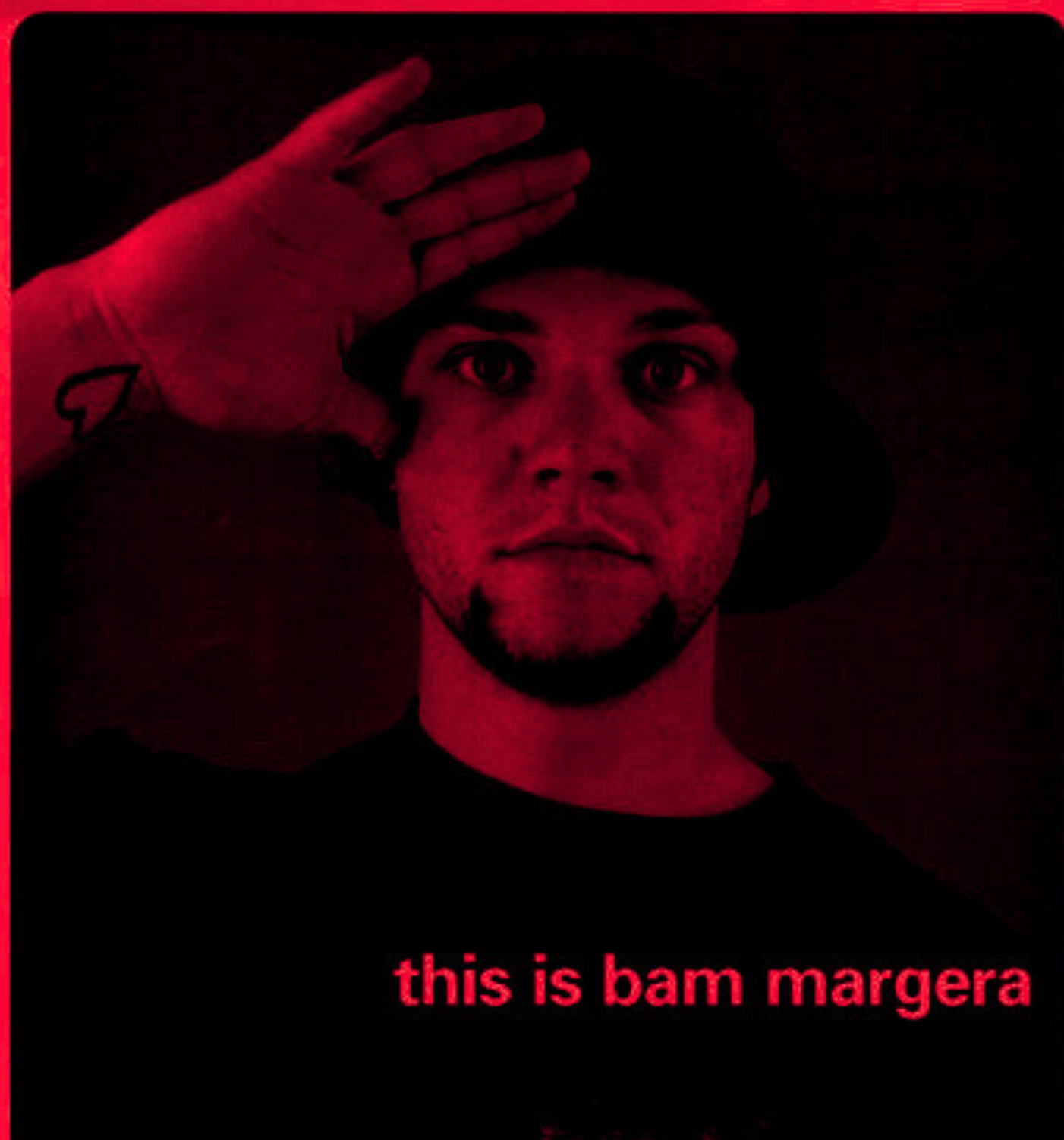
Source: Skately
In 1995, Big Brother magazine travelled the country to shoot different local skate scenes. The goal was simple: go to parks and competitions, photograph some cool people, and party. These country-wide tours would prove to be fairly myth-making for the crew. In 1997, they stopped in New Mexico and watched a guy light his face on fire. You can guess where that went.
However, when they were in Philadelphia, this little punk caught their attention with his daring tricks. The kid was a prodigy, a total phenom. It was that night that Jeff Tremaine met Bam Margera.

Credit: Big Brother Magazine
Bam’s entire life was built around skating: he spent all his time practicing instead of going to school, his parents took him to competitions, his friends shot his tricks, there was never really an option for him to do anything else, and he didn’t want to. In this environment, way, way before Jackass, he won championships, earned sponsorships, and received regional notoriety just because he was a good skateboarder.
He’s also Bam. And while a lot has happened in the decades between then and now, he has always been very funny and really creative and disarmingly clever. This brashness launched him to subcultural stardom.
With the help of his skating friends and after stealing the name from his brother, Bam made Camp Kill Yourself, not only an inseparable crew, but a film project born out of a media class they all took together — Bam, Dunn, Dico, Raab Himself, and Rake Yohn. By combining his skate tricks with pranks and stunts, Bam Margera and his friends produced, directed, and circulated CKY and CKY2K. These films created a very clear idea of Bam Margera™ that only got clearer with more releases.
There’s a kind of pause Bam experts give on this topic: when does Bam end and Bam Margera™ start? It’s clear that at the beginning that the Bam we know was a kind of character. Like in those early days, he wasn’t being totally himself on camera. Instead, he was doing an impression of the most obnoxious skateboarder traits possible: he was gross and weird and hilarious. Kind of like if Big Brother magazine was sentient. But there was a line. Real Bam was more business-minded, more directorially gifted, and by all accounts, really sensitive. I would go so far as to say he was an ingénue, too. An ingénue in dirtbag shit at least. But no one had to know that. He knew that people didn’t want to see the real Bam; they wanted a wild friend.
He became a countercultural icon before he was even on TV.
Once Jeff Tremaine and Johnny Knoxville got hold of Bam’s movies, Jackass was born. Quickly, the split between Bam and his character was gone, vices entered the picture, a pop culture icon was discovered, and a rock star was made.

Credit: Unknown
Let me be so clear: Jackass needed Bam. Bam never needed Jackass.
There’s a swagger to Bam that no one else has. Johnny Knoxville is a symbol more akin to Bugs Bunny and John Waters and Evel Knievel than a Mick Jagger-type, even if he is a bit cold and calculating at times. Steve-O is brought up the same way people bring up controversial comedians iconic to a particular time, like Andrew Dice Clay in the 80s or Carrot Top in the 90s. He’s closer to Dane Cook or Daniel Tosh than Ronnie Wood.
Bam has a creative mystique that the others don’t. He’s more omniscient than Just Jackass, and he can still subsist in TMZ articles in ways the others can’t. The point of this essay isn’t to claim that Bam Margera is the Keith Richards of Jackass or something, but the comparisons are there for sure: a life of hard drugs, fast cars, and the story of Chuck Berry punching Keith is probably comparable to the story of Tony Hawk asking Bam if he was bulimic.
The point of this essay is to explain that when Tony Hawk supposedly asked Bam if he was bulimic, Bam was selling more skateboards than him.
What is danger anyway, at least in this context? I see it as a feeling or a presence, or for lack of a more specific word: a vibe. It’s the sense that this person has a sneaky upper hand, but things could still go wrong in a second. Like they’re on a constant tightrope walk or have a pre-existing bargain with the threads of reality itself. These things could probably go wrong because of something they do to themselves, and that’s probably whatever they’re famous for. A tinge of doom follows them, but just on the edges. In rockstardom, this danger requires someone who has a looming presence in any room they’re in and a strong, personal attitude. They don’t need to be mean, but they need to be menacing in a way, intimidating by just existing.
Jackass is a dangerous show. There’s a whole warning at the beginning of every episode, semi-begging people not to try what they do because it’s so dangerous.
I talk about this in a different essay, but the crew gets legitimately hurt doing what they’re doing. Ryan Dunn had an injury-induced blood clot that stopped him from working on the video game, Johnny Knoxville infamously gave himself a brain hemorrhage in Jackass Forever, and a broken back is the reason why there aren’t any women in Jackass (I’m sowing the seeds for another essay here). You might have never noticed this, but Bam doesn’t really do anything in Jackass: The Movie.
That’s a bit rude-sounding; he obviously does a lot, like he’s throwing fireworks into his dad’s work van from home and terrifying his mom with a crocodile also from home. But go back and watch it, he’s wearing a back brace in a couple scenes, missing from others, and only steps in for stuff that was clearly filmed at weird times or kind of hosts the stunts from a distance. I guess my running theory is that he was hurt during the period they filmed the majority of the movie and his pieces are in more of a clip format. There’s a lot of moments like this on Jackass, but I’m establishing an offscreen danger here. Bam getting injured before the first movie even kicked off is a weird little reminder of how well established this daring lifestyle was, it exists in and out of Jackass, and how much he worked for it.
But you didn’t even notice this, did you? He’s so present in the movie that you don’t care when he doesn't even do anything.
Like all rock stars, his celebrity isn’t based on The Thing he does necessarily, not like the other Jackass guys. He, of course, has to be well established in being good at jackassery and whatever, but like Keith Richards, it’s more about the idea of him being good at something than proving the skill over and over. Stones fans may disagree with me on that, but Keith Richards could live this lifestyle because he already proved he’s good at making rock music; he doesn’t need to reiterate that every time the Stones release a record. He will always be Keith Richards, the kickass guitarist, and you won’t really associate the bad Stones albums or any weak riff he wrote with him personally. Similarly, Bam, at this point, has already proven himself to be cool and badass and whatever, he just needs to keep elaborating on that perception; he doesn’t need to invent new tricks anymore.
This idea of the oeuvre of dangerous rockstardom, the pieces or ingredients, isn’t foreign to Bam, because Bam isn’t the rock star in his own life. Ville Valo is Bam’s rock star. Valo is the frontman of HIM, the rock band that Bam was obsessed with when he was new to stardom. Valo, a real rock star, introduced him to cooler clothes, cooler music, and the cool heartagram that became his logo. He also introduced Bam, who was fairly sober in the first years of fame, to real partying. In Bam’s words: "I remember when me and Ville Valo were out in London and he woke up at noon, opened up the mini bar and cracked open a beer. That was the first time I was introduced to day drinking." A Real Rock Star Lifestyle was forming.
“I remember when I was probably 24, I was so mesmerized by Ville Valo from HIM… he would just walk down the street in Finland and girls would literally faint, sometimes guys too. So I would just follow his lead. I’m like, ‘He’s buying a pack of cigarettes, I’m buying a pack of cigarettes. He’s getting a beer, I’m getting a beer. He’s doing a shot of Sambuca, I’m doing a shot of Sambuca.’” – Bam Margera
There’s a really distinct visual difference between Bam in Jackass: The Movie (and the show) and Bam in Jackass Number Two. In the first movie, you can see a kind of semblance of personal style forming, but by the second, Bam has the tattoos, eyeliner, gothic coats, and fingerless gloves that made him a fashion icon. His personality changes, too; instead of getting caught between Bam and Bam Margera™, he embraces Bam Margera™. Wilder, louder, funnier, angrier, and crueler.

Credit: Unknown
It’s here that I’m curious why this danger and this character-making are crucial to rockstardom. With this proven threatening personality, unattainable lifestyle, and instantly recognizable look, Bam is mythmaking and cementing himself as a dangerous rock star. But is he just contorting himself to fit in a rock star-shaped mold? Or does he naturally have the pieces to make this life real? I think it’s both: he had an image of who he needed to be and became that, but it wasn’t a stretch from the Bam Margera established before; this one was just more recognizable.
But this rockstardom has to go somewhere. This danger can’t just fester; it has consequences.
When you rewatch those early Jackass movies, there’s a tension that something big will go wrong for Bam; he’s a real dangerous rockstar, I guess.
Obviously, the project is generally designed this way for everyone, but I’m not talking about the aftermath of a stunt. I’m talking about the feeling that something big is going to go wrong, and it’s not going to be a broken back, and it’s not going to be an infected brand. The stunts were unruly, the self-protection was nonexistent, the obsession with getting the shot at any cost was almost unbearable, but that’s not it. Things did go wrong; they always went wrong — Steve-O overdosed, Chris Pontius was homeless, projects were cancelled, the Senate went after their show — but there’s a distinct feeling of doom that lingers over Bam Margera.
He was too present, too controversial, too dangerous.
My favorite Stones performance is a 1975 video of Keith Richards singing “Happy.”
The Stones have changed the way “Happy” is performed over the decades, from a group number to a Keith solo and back again. But in the 70s, the choreography was standardized. Keith would sing his song, and Mick would join in on the chorus. Here’s a very jock-y version in 1972 featuring Keith’s missing tooth and a very blurry version in 1973 where Mick has a cropped haircut. Despite being a personal song for Keith, “Happy” was an opportunity for the Glimmer Twins to glimmer, a moment for them to revel in their clever lyrics and roiling guitar solos. But this performance in 1975 at The Forum is wrong; it’s too tense and too loose at the same time. Something bad is brewing between them.
The performance starts with Mick Jagger telling the crowd that Keith is about to sing “Happy,” but it feels more like he’s alerting Keith than the audience. After his public service announcement, he turns directly into Keith, who is handing him his half-smoked cigarette. Plumes of smoke billow around them, Keith mid-laugh, while Mick plucks it out of his fingers and turns on crocodile leather heel to put it out in the ashtray.
The song kicks in, and like the charismatic showman he is, Mick Jagger jumps around the stage alone. Everyone else is dialed into their Stonesian music soup. Thin legs in tight leather pants, balancing instruments. This is the standard performance. The spotlight glows on him as he amps up the audience and shakes his hips and does whatever it is that Mick Jagger does. The only problem is that Keith is not at the mic.
So, Keith misses his own lyrical cue and eventually recovers, but that doesn’t stop Mick from stopping mid-galavant to monitor him carefully from across the stage. After a second mistake, Mick is back at his microphone, not joining Keith for his regular chorus support, but singing the song for him. They’re pressed against each other, also standard, Mick’s eyeshadow shimmering blue while a sheen of sweat collects across Keith’s nose. But there’s an annoyance radiating from Mick, not standard. While they did usually sing this song together, for this performance, Keith’s autobiographical song becomes a true duet of necessity.
Mick keeps a laser focus on the distant audience, not looking at Keith, but sensing him as he sways back and forth. Meanwhile, Keith sings whatever lyric he feels like, focusing more on his guitar, almost in a trance of just physically feeling the music rather than performing live. Keith is also not looking at Mick, but he’s not looking at anything at all; his eyes are shut the whole song. The YouTube comments have diagnosed him with a gnarly opiate high.
Keith’s scratchy voice is made raspier by whatever state he’s in, and a wicked smile flits across his face when Mick gives the mic back to him. The whole video continues like this, aided by the drama of tight shots and the vague idea of a crowd. Mick reappears constantly at his shoulder, not to sing his parts as usual but to catch Keith where he’s slipping and right the Rolling Stones ship.
Eventually, Mick takes his microphone back and finishes the final verse as Keith relegates himself back to his station, strumming the last parts of the song while Ronnie Wood plays the slide parts, unbothered by whatever was going on, a cigarette bit between his teeth. Mick’s performance, again, is not necessarily abnormal, but he’s clearly off. Mick’s normal stage antics feel exasperated as he continues to stare at Keith, who is still not looking at him.
It’s such a concentrated, potent, Keith Richards moment, a rock star moment, a dangerous moment. He’s simultaneously embracing the allure of the Stones and undermining the whole project. With just a couple of missed beats, he manages to shake Mick Jagger’s unshakeable confidence while giving the exact performance Stones fans expected from the drug-addled bad boy of the band.
My least favorite Jackass project is Jackass 3.5.
Its sister, Jackass 3D, is tense but 3.5, a compilation of all the cut footage with commentary from the crew, feels wrong. It’s always ridiculous to say stuff like that; it's Jackass, they’re just doing what they always do, like getting stomped on by bulls or puking in an astronaut helmet. But when there's tension in the group, it’s palpable; when someone crosses a line, it’s real. Jackass 3D, for all its slow-motion camera glitz and 3D glam, is mean-spirited. Everyone’s star is fading, people are between sobriety journeys, and Knoxville is legitimately cruel in what he puts people through as they’re struggling for paychecks. They had real pressure to make Jackass relevant in the true Internet age, and they delivered, but there was a cost.
Jackass 3.5 is worse. Steve-O is missing from the introduction, Brandon Novak broke his ribs in one stunt, Danger Ehren broke his neck in another, the commentary is terse, the social lines in the sand are clear. But nothing feels as truly bad as Bam’s cut footage.
Perhaps this danger comes from how much his segments don't match the tone of the rest of the video. While Knoxville is refusing to accept blame for his corporal treatment of the crew, and Jeff Tremaine is grappling with how much people don’t like him live on camera, nothing Bam does works.
Throughout all the outtakes, Bam’s stunts just don’t happen right, which is standard for the .5 series (it’s outtakes after all), but he’s so defeated by it. He can’t land a skateboarding trick he could have ten years before, he can’t get a funny take of even the most ridiculous stunts, and ultimately, he’s relegated himself to just doing some whatever with Ryan Dunn to the side. He also doesn’t have anything particularly unique to bring; for example, after telling the whole crew he’s the only one who can do a double face kick, Dave England knocks him out. And to make it worse, it’s not just internal frustration: one of the more damning moments is when Spike Jonze briefly forgets that Bam dressed up as an old man with him and Knoxville in the first movie. Another low point is when Rick Kosick breaks up a real fight between him and Danger Ehren. His cocky dirtbag routine isn’t flying in these clips, and he can’t even win it back in the commentary; he can hardly summon the charisma to make it watchable.
What’s wrong here is the loss of Bam’s bigness. He seems small in his chair, uncool even as he constantly messes with his scarves. While Jackass Number Two was a post-Viva La Bam victory lap, Bam’s stardom here is rusted for the first time, and his life has slowed down at this point. Instead of rivaling Knoxville for notoriety, he feels almost relegated to the background.
If we have established that Bam doesn’t actually need to do a bunch of stunts to be notable, he just needs to be himself, he has lost that iconic self here. He’s too loose and too uncontrolled. This Bam is not the Bam that people pay to see; he walks and talks like him, but this one is untethered, stuck in the motions of what once was. Not the sensitive guy he was, not Bam Margera™, just a diminished version.
If rockstardom is predicated on the feeling of dangerous public personalities, it’s missing here. There’s a sense of downfall instead, a sense of dread to come. This unmoored Bam feels dangerous, but more like a real danger than the idea of danger that he has built his life around. The tinge of doom is closing in. It’s here that his aesthetic authenticity is crumbling, leaving only impending tragedy.
In 2001, Big Brother magazine ran a picture of Bam Margera balancing precariously on his board. The picture is mostly an ad — his new deck is clearly in view and he’s obviously modeling a shoe. It’s a pretty standard, unremarkable picture, except for the tiny, descriptive text in the corner. “Take a good look at Bam’s fakie noseblunt so you can tell your grandkids how you knew him before he turned into a superstar, got fat, O.D.’d and died.”

Credit: Big Brother Magazine
Bam isn’t a rock star anymore. He was at one point, he was a really good one even, but the elements that kept his mystique and intrigue fell apart. Not even at his own doing, just the relentless cycling of popularity.
But he always stayed dangerous. He’s dangerous now. He’s still in gossip rag headlines and still stoking controversy. I would say Keith Richards is still dangerous too. He’s the only person who has experienced that whirlwind life he crafted, and he is still playing his cool guitars. I think this danger doesn’t go away; once it's been built into your public character, it's permanent. People will always think about that thing you did or said that they never would dare and how it made them feel to witness it.
I think an unexpected conclusion I (and my editor, CJ) have reached is that this is genuinely sad. I wrote something about tragedy at the top, but I am talking about real, granular sadness every day. This dangerous lifestyle is cool, and there’s a hunger people feel for it, but if it doesn’t go right, it is singular, lonely, and sad. Maybe it is if it goes right too.
There’s also a guilt that comes with watching rockstardom play out right? Crowds only ascribe value to them if they keep the danger up. In the words of CJ: danger is in seeing something lit aflame but not in seeing it burn. When something burns, audiences don’t know what to make of it. Maybe it's guilt or disgust with themselves, maybe it’s a disinterest and entrapment in a media cycle.
I don’t want to end this essay on the melodramatic idea that rock stardom is particularly tortured and bloodthirsty fans are to blame, but isn’t that kind of where these things go? Where does danger go when you have nothing to be dangerous about? When you can only wield it against yourself and others?
I said at the beginning that there’s a sacrificial nature to all this. How, in order to maintain aesthetic authenticity, there is no escape from this lifestyle. This is what makes icons. But it also makes tragedy. Again, I hesitate to point at a man who has openly struggled these past 15 years and call him a tragedy, I don’t think he is and I think that’s limiting. But I do think people look at him tragically. His perceived tragic-ness now outweighs his icon status. You can’t talk about Bam then without people bringing up Bam now and if someone names a tangible contribution during his time in the spotlight, it causes real, but brief conversation — akin to nostalgia baiting or maybe deeming him unappreciated in his time. For the record, he was appreciated in his time.
When Big Brother published the “Take a good look at Bam’s fakie noseblunt so you can tell your grandkids how you knew him before he turned into a superstar, got fat, O.D.’d and died,” blurb, they were doing it because Bam was obviously a star. It’s a joke, but a grim acknowledgement of the lifestyle he was barreling into and the challenges he would face to maintain his created self. They’re sad for him in advance.